You already reach them.
Now speak to them.
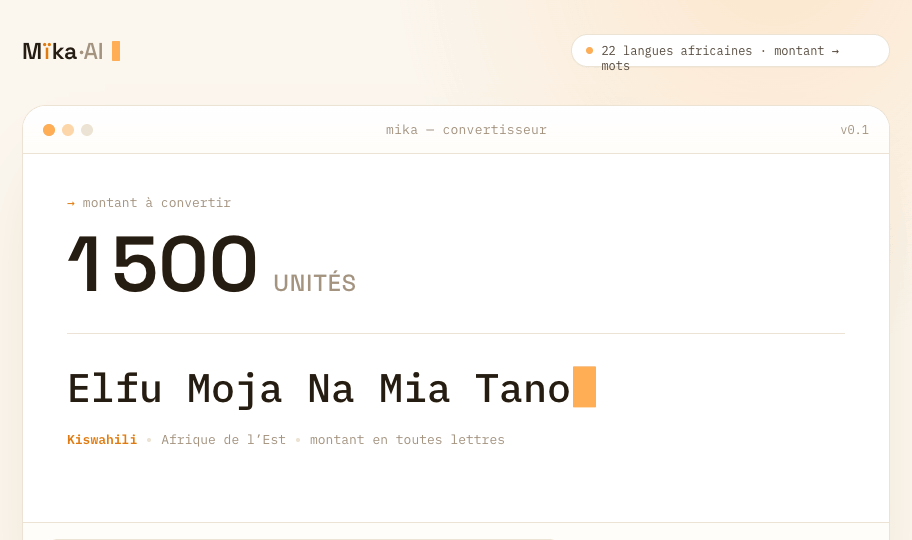
Install Mbase on your own servers. Ask it for an amount — it returns the text and the voice, in 20 languages. Every channel you already run can use it, and nothing leaves your network.
Try it in the browser first, or install the Console and buy credit. See where it works →
What your subscriber hears, and where Mbase sits to say it.
Same moment, two ends. Switch between what lands on the handset and what changes inside your platform — which is almost nothing.
The subscriber taps the amount and hears it in the language they actually speak. No app to install, no new habit to learn.
- Nothing is written downNo message left in an inbox, on a lock screen, or in the SMSC log. The balance exists for the seconds it is spoken.
- Spoken only after authenticationThe callback happens on the line the subscriber just authenticated on — not to whatever handset holds that SIM.
- It works if they cannot readThe subscriber who most needs their balance in Fongbé is often the one who will never read it in French.
The voice path uses the same instance and the same request — only the output profile changes: telephony, µ-law 8 kHz, handed straight to your IVR over MRCP.
Nothing in the left column is replaced. Your platforms keep their protocols and ask one more question, on your own network — and get back the right format for the channel they serve.
Mbase is one piece of
something larger.
Maïka
Maïka is the multilingual model HMTC is training for African languages, domain by domain. Mbase is the first piece that is finished — and the one you can license today.
Imagine your technology speaking their language.
Twenty languages, one ring. Each segment has the same thickness; only its length changes, in proportion to potential speakers. Click a segment to read that language alone.
English, Swahili, Arabic and French carry two thirds of the ring — and every vendor already does them. The second view removes those four: what remains is what nobody else has built.
Potential speakers, cumulative. One person can be counted in several languages: a Beninese speaks Fongbé and French. This is a reach figure, never a population.
Three services, four channels, one machine you own.
This is the Diagnostic view of the Mbase Console, drawn for reading. The server sits in your LAN; the Console watches it from an administrator workstation; nothing leaves the network.
Where it works, and for which line of business.
The ring says how many. The map says where, and for whom. Pick a business domain, then click a country to see its languages and its status domain by domain.
An on-premise engine. It runs inside your network — not ours.
Security stays where your data already lives — nothing transits through us. Requests resolve on your own network, so latency is whatever your LAN allows, not what the internet allows. And deployment stays entirely under your control: Mbase slots into whatever infrastructure strategy you already run — cloud, hybrid, or fully offline.
- Licence check, localSigned Ed25519 certificate, verified on the machine, no network involved. Activation needs the internet once.
- Assets encrypted at restAudio assets are decrypted in memory only, never written in clear on disk.
- TLS pinned per machineSelf-signed per host, SHA-256 fingerprint pinned on first connection — independent of any external CA.
These languages are not a missing voice. They are a missing grammar.
A CTO asks the question in three minutes: why not AWS Polly, why not Google Cloud TTS. Because they do not do these languages, and will not — not for lack of means, for lack of material.
- Fongbécounts in twenties: tiers
{1..10, 15, 20, 30}and a precise residue rule. - Adjapicks the connector
von,rhouorkododepending on context. - Fulfuldeswitches from
mbuuɗitofaranjifrom 50 000 up.
None of these numeration grammars existed in software before HMTC. They were extracted, formalised, ported to Rust, and validated by 1 216 parity tests passing at 100%.
Compositions verified in production. The asset is not the code — it is the linguistic knowledge nobody else took the trouble to build.
Call it from your own network.
One local HTTPS endpoint, on your machine, on your port. The same call from a terminal, from your billing platform, or from your IVR.
# On your host, in your LAN
curl -X POST https://mbase.lan:8712/api/compose \
-H "Content-Type: application/json" \
-H "Authorization: Bearer <role-token>" \
-d '{"domain":"finance","lang":"fon","amount":12300}'
- Amount to wordsComposed with the numeration rules of each language, not a generic template.
- Audio in the same callText and speech from one request, served by the machine you own.
- Roles and tokensBearer tokens per role, counted locally, no external directory.
- Six export languagescURL, Python, Node.js, PHP, C++, C — generated by the Console.
Meet the team.
A pan-African team of researchers and engineers democratizing AI from the continent — across Bénin, Ghana, Togo, Nigéria and Éthiopie.
Deploy it in your own network.
One key, one machine, one afternoon. You buy a product key, install the Console, and provision your host — the embedded ReadMe takes it from there.